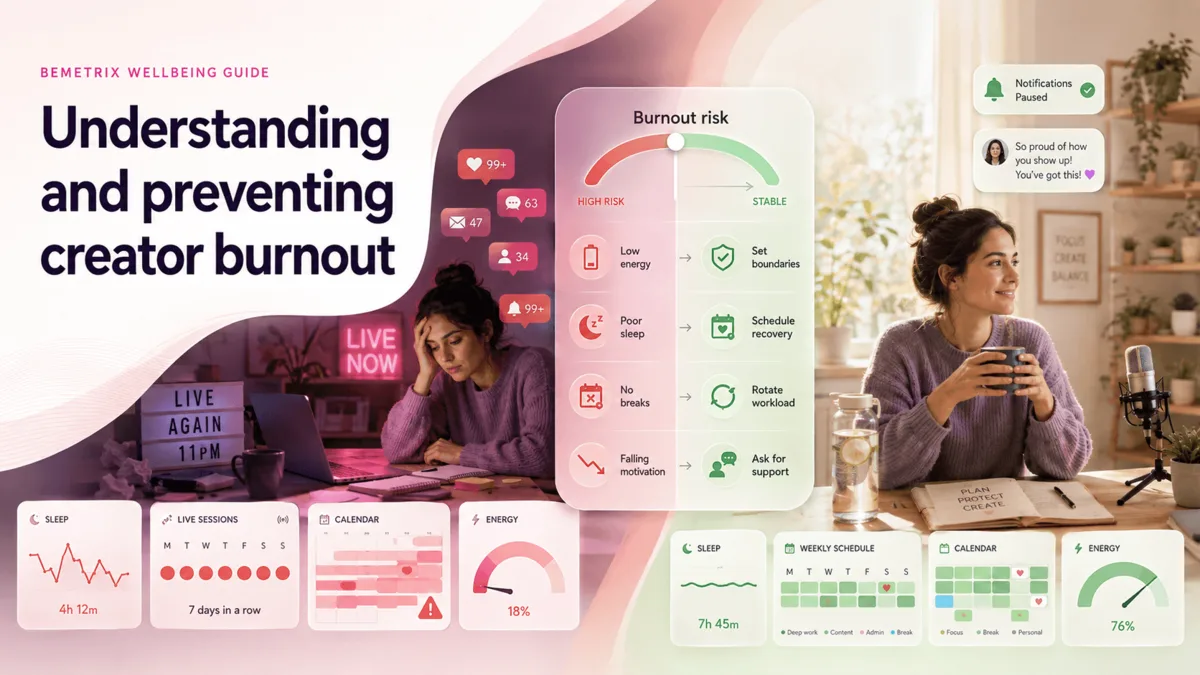
Burnout is an operational problem
It is tempting to treat burnout as a personal resilience issue. In practice it is usually structural: unpredictable schedules, unclear expectations, no recovery time, and performance pressure without support. Those are all things a studio controls — and a solo creator can control for themselves.
The early signals
Burnout announces itself before someone quits. Watch for:
- Declining hours without a stated reason.
- Flat or falling earnings on a stable schedule — effort without engagement.
- More last-minute cancellations, especially on previously reliable days.
- Shorter sessions and less interaction during them.
- Withdrawal from team communication.
Any single signal is noise. Two or three together, sustained over a few weeks, is a conversation that should happen now rather than later.
What actually helps
Predictability
Irregular schedules are one of the strongest contributors to exhaustion. A fixed weekly pattern, published in advance and changed rarely, lowers the cognitive load of the job before anything else does.
Guaranteed recovery time
At least one full day off per week, protected. Not "when things are slow" — scheduled, and treated as immovable as a shift.
Realistic targets
Targets set from someone's own trailing performance are motivating. Targets set from the roster's top performer are demoralizing. Use each person's own baseline.
Separation between the persona and the person
Long-term sustainability depends on the persona being a role rather than an identity. Practical support: clear boundaries about what is never shared, permission to end sessions that turn hostile, and explicit backing when a boundary is enforced.
Meaningful feedback
Regular short reviews focused on what to change, not just on numbers. People burn out faster when effort feels unobserved.
For solo creators
- Set a weekly hour cap and treat it as a hard limit.
- Book time off in advance and announce it — audiences handle planned absences far better than sudden disappearances.
- Track earnings per working hour, so scaling back does not automatically feel like failure.
- Keep one non-work commitment on the calendar every week that other things move around.
For studios: build a check-in cadence
A short, scheduled conversation every few weeks — about workload, schedule, and problems, not just performance — catches most issues while they are still fixable. Pair it with an automated review of activity changes so nobody quietly slips off the radar between conversations.
The business case is straightforward. Recruiting and onboarding a replacement costs more than the accommodations that would have prevented the departure, almost every time.

Related articles


Get more like this in your inbox
Industry insights, best practices and product updates — once a week.